All styles
Every style this tool generates, with a live preview of each rendered in itself. They come from several different Unicode blocks, and that origin is what determines how widely each one is supported. The mathematical alphanumeric styles were added in 2001 and are covered by almost every modern font, while the enclosed and supplement blocks arrived later and are covered less consistently. Each style page explains where its characters come from, which platforms handle it cleanly, and where it tends to break. If you are choosing one to use somewhere that matters, start with the ones drawn from the mathematical block.
How to choose one
Thirty styles is more choice than anyone needs, so here is the shortest useful version.
If it has to be read, use bold, sans bold or small caps. All three keep their letterforms at the size a phone renders a bio, and all three come from parts of Unicode covered by essentially every font shipped in the last twenty years.
If it has to stand out more than it has to be read, bold script, gothic and vaporwave carry the most character. Expect them to fail on some older Android handsets, and keep them to a line rather than a paragraph.
If your text contains numbers, check before you commit. Twelve of the thirty cover digits and eighteen do not, and there is no pattern you could guess: every italic and cursive set lacks them, and the enclosed blocks are uppercase-only.
Where these characters come from
Most of what is here comes from the Mathematical Alphanumeric Symbols block, added to Unicode in 2001 so that a physics paper could distinguish a bold vector from an ordinary variable. That academic origin is the reason bold and italic render almost everywhere, and the reason several styles have gaps: a handful of positions were already occupied by characters allocated years earlier, so those letters had to be borrowed back from an older block.
The rest is assembled from wherever a resemblance exists. Small caps comes chiefly from Phonetic Extensions. Fullwidth comes from East Asian typesetting. The lookalike styles substitute letters from Greek, Cyrillic, Cherokee and Runic, which is a different proposition entirely and carries its own warning on each page.
What every page tells you
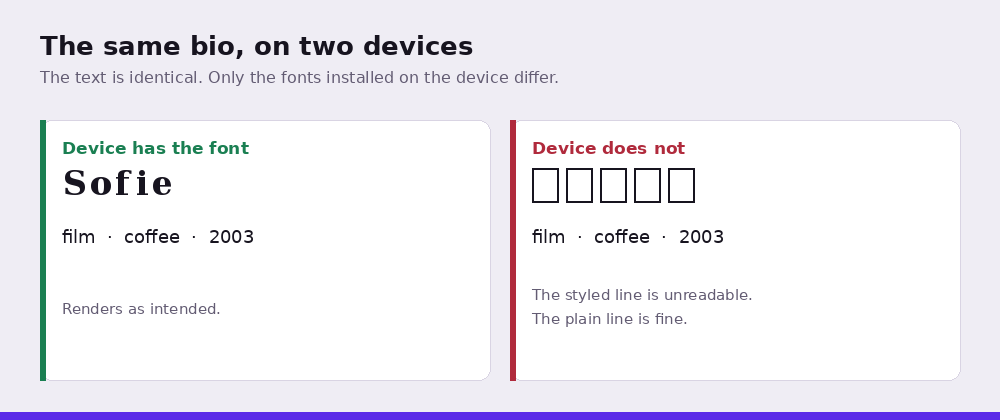
Which Unicode block the characters come from, with the codepoint. Which platforms render them and which strip or reject them. Whether digits are covered. And where the style breaks, because a name that arrives as empty boxes is worse than a plain one.
- Bold italic generator: copy and paste 𝑩𝒐𝒍𝒅 𝑰𝒕𝒂𝒍𝒊𝒄 text 𝑩𝒐𝒍𝒅 𝑰𝒕𝒂𝒍𝒊𝒄
- Bold script generator: copy and paste 𝓫𝓸𝓵𝓭 𝓼𝓬𝓻𝓲𝓹𝓽 text 𝓑𝓸𝓵𝓭 𝓢𝓬𝓻𝓲𝓹𝓽
- Bold text generator: copy and paste 𝐛𝐨𝐥𝐝 letters 𝐁𝐨𝐥𝐝
- Bubble letters generator: copy and paste Ⓑⓤⓑⓑⓛⓔ text Ⓒⓘⓡⓒⓛⓔⓓ
- Cherokee text generator: copy and paste ᏟᎻᎬᏒᎾᏦᎬᎬ style text ᏟᎻᎬᏒoᏦᎬᎬ ᏚᎢᎩᏞᎬ
- Circled negative generator: copy and paste 🅝🅔🅖🅐🅣🅘🅥🅔 text 🅒🅘🅡🅒🅛🅔🅓 🅝🅔🅖🅐🅣🅘🅥🅔
- Clean text generator: copy and paste 𝗌𝖺𝗇𝗌 𝗌𝖾𝗋𝗂𝖿 text 𝖲𝖺𝗇𝗌 𝖲𝖾𝗋𝗂𝖿
- Cursive text generator: copy and paste 𝒸𝓊𝓇𝓈𝒾𝓋𝑒 text 𝒮𝒸𝓇𝒾𝓅𝓉
- Cyrillic text generator: copy and paste Суrillic style text Сугілліс Ѕтуле
- Glitch text generator, copy and paste Ḡ̗̠̗̂̒l̟̤̤̄́̑ī̫̦̗̈́̌t̝̪̠̆͂̋c̦̰̖̆̒̋h̘̗̠̆̑̊
- Gothic font generator: copy and paste 𝔤𝔬𝔱𝔥𝔦𝔠 text 𝔉𝔯𝔞𝔨𝔱𝔲𝔯
- Greek text generator: copy and paste Ελλην style text Γγεεκ Στψλε
- Heavy glitch text generator, copy and paste Ḡ̘̰̩̜̟̦̂̒́̊́l̫̜̗̰̗̥̄́̑̈̋̋ī̦̤̞̥̦̥̈́̌͂̑́t̠̪̦̝̞̤̆͂̋̆̓̊c̝̘̖̖̖̤̆̒̋̑̈́̀h̗̟̜̦̦̠̆̑̊̂́̊ ̫̩̤̞̝̟̇̋̈̋̃̈́Ḣ̦̗̫̘̖̟̊̇̈́̆̈ė̟̞̙̪̥̞̇̇̇̈̈́ä̜̦̠̠̜̞̆̆̒̋̈v̗̖̩̙̰̝̈̄̄̃̑͂ÿ̫̝̗̫̤̝̂̃̌̒̇
- Italic text generator: copy and paste 𝑖𝑡𝑎𝑙𝑖𝑐 text 𝐼𝑡𝑎𝑙𝑖𝑐
- Monospace text generator: copy and paste 𝚖𝚘𝚗𝚘𝚜𝚙𝚊𝚌𝚎 text 𝙼𝚘𝚗𝚘𝚜𝚙𝚊𝚌𝚎
- Old English font generator: copy and paste 𝖔𝖑𝖉 𝖊𝖓𝖌𝖑𝖎𝖘𝖍 text 𝕭𝖔𝖑𝖉 𝕱𝖗𝖆𝖐𝖙𝖚𝖗
- Outline text generator: copy and paste 𝕠𝕦𝕥𝕝𝕚𝕟𝕖 text 𝔻𝕠𝕦𝕓𝕝𝕖-𝕊𝕥𝕣𝕦𝕔𝕜
- Runic text generator: copy and paste ᚱᚢᚾᛁᚲ style text ᚱᚢᚾᛁᚳ ᛋᛏᚣᛚᛖ
- Sans bold generator: copy and paste 𝘀𝗮𝗻𝘀 𝗯𝗼𝗹𝗱 text 𝗦𝗮𝗻𝘀 𝗕𝗼𝗹𝗱
- Sans bold italic generator, copy and paste 𝙎𝙖𝙣𝙨 𝘽𝙤𝙡𝙙 𝙄𝙩𝙖𝙡𝙞𝙘
- Sans italic generator: copy and paste 𝘴𝘢𝘯𝘴 𝘪𝘵𝘢𝘭𝘪𝘤 text 𝘚𝘢𝘯𝘴 𝘐𝘵𝘢𝘭𝘪𝘤
- Slash through generator: copy and paste s̸l̸a̸s̸h̸e̸d̸ text S̸l̸a̸s̸h̸ T̸h̸r̸o̸u̸g̸h̸
- Small caps generator: copy and paste ꜱᴍᴀʟʟ ᴄᴀᴘꜱ text Sᴍᴀʟʟ Cᴀᴘꜱ
- Squared text generator: copy and paste 🄱🄾🅇🄴🄳 text 🅂🅀🅄🄰🅁🄴🄳
- Strikethrough text generator, copy and paste S̶t̶r̶i̶k̶e̶t̶h̶r̶o̶u̶g̶h̶
- Subscript generator: copy and paste ₛᵤᵦₛcᵣᵢₚₜ text Sᵤbₛcᵣᵢₚₜ
- Superscript generator: copy and paste ˢᵘᵖᵉʳˢᶜʳᶦᵖᵗ text Sᵘᵖᵉʳˢᶜʳⁱᵖᵗ
- Underline text generator, copy and paste U̲n̲d̲e̲r̲l̲i̲n̲e̲
- Upside down text generator: ʇxǝʇ uʍop ǝpısdn ǝʇsɐd puɐ ʎdoɔ ∩dsᴉpǝ ᗡoʍu
- Vaporwave text generator: copy and paste wide text Fullwidth